Showing posts with label generational issues. Show all posts

5.09.2007

Games, Gaming & Libraries

Jenny Levine, Internet Development Specialist and Strategy Guide
American Library Association
Aaron Schmidt, Director
North Plains Public Library


Levine and Schmidt shared current video gaming statistics and best practices for planning and hosting a gaming event at the library.
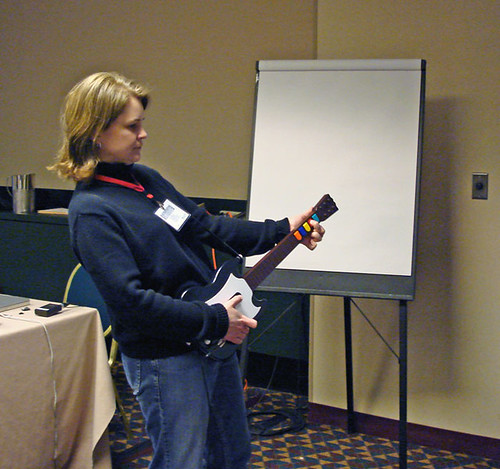
The average age of today’s gamer is 33 and the largest group of gamers is middle-aged women. The majority of video games are suitable for use in libraries, with only 15% of all games released in 2006 rated M for Mature by the Entertainment Software Rating Board (ESRB). Gaming programs allow libraries to be valuable contributors to 21st century learning and the education system.

Levine offered this tip for working with young people, many of whom are avid gamers. In play, the gamer is focused on beating “the boss”— a villain that must be conquered before the player can advance to the next level of play. Gamers will keep trying until they find the best way to accomplish this. It is part of their learning and social style to “beat the boss.” For this reason, it is important that library staff refrain from too much bossy behavior when working with young people—especially gamers—to avoid playing into the young person’s instinct to… well… beat the boss.

Schmidt shared his experience with gaming at his library and offered several suggestions for planning and hosting a gaming event.

  • Allow teens to share their equipment for the program. It gives them a sense of ownership and lets them feel that they are part of the program
  • Connect the gaming system to an audio/video projection system to create a larger-than-life playing experience
  • Decide whether to host a tournament or open play
    • Tournament play involves more planning and can discourage casual gamers from participating, but has added value for participants
    • Open play is easier to plan and more friendly and inviting atmosphere but has less added value for participants
  • When gaming on the Internet, encourage responsible online behaviors such as logging out of player accounts and keeping passwords private.
  • Use program downtime to harvest audio, video, and other Web content from participants such as comments on the event, book review podcasts, and feedback statements.
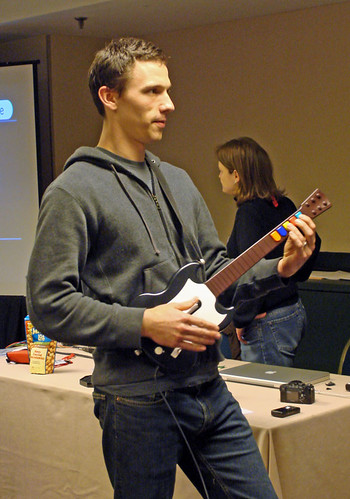
Schmidt also addressed briefly the disruptive behavior often experienced in libraries where young users play Runescape. He compared their behavior to adult users who become belligerent, rude, and loud when they can’t get online or don’t want to pay a fine. In libraries where behavior has become a problem, he suggests a two-hour window of Runescape play each day. If and when behavior gets out of hand under any circumstances, gaming privileges can be revoked. In his experience, the kids respond well when under threat of losing their gaming privileges.

4.16.2007

Millennials and the Library

Marshall Breeding from Vanderbilt University spoke about generational transitions and the current “millennial” generation, those born between 1981-2000. In an academic setting in which Mr. Breeding works, Millennials are the majority of patrons. The basic generational assumptions are that people born during this time have an innate ability for technology, are accustomed to frenetic multitasking, are comfortable with diverse types of digital media, and have a highly interactive style of working.

In developing collections, think of Content, Discovery, and Access. In the area of content, focus on digital collections: audio, video, podcasts, ejournals, ebooks. Discovery refers to the hyperlinked serendipity that happens through regular web surfing—for example, looking up a title in the catalog, reading user reviews, listening to the author interview. The access, then, to library services should be Anytime Anywhere.

As we consider ways to reach out to our teen and young adult users, these are all things to keep in mind. However, it’s not just the library user that needs to be considered. The Millennial generation is the next group that will be working in libraries. Will the library as workplace be welcoming to those who are accustomed to receiving info quickly and from multiple sources; like to parallel process and multitask—listen to music, talk on the phone, answer email all at the same time; work in peer groups; learn while doing instead of the traditional read-then-do learning model?

Also think about website design. Heightened user expectations (all users, not just millennials) require that pages load quickly and that interfaces are highly graphic, not text-based. Consider the conventions in web design that seem to have missed the Library Boat: navigation, simple search interfaces with minimal textual instruction. Mr. Breeding touched on traditional library website design, which he describes as “status quo”, require too much jumping through hoops to get to the content, and are designed for librarians who are text-based learners.